
UK policy
What are the UK’s carbon emissions?
Want to know how the UK is contributing to climate change? In this post, we look at the UK’s carbon emissions today and how they have changed over time.
 By
Jamie
By
Jamie
We look at the laws on climate and environment that all governments have to stick to, before exploring the pledges and actions across different policy areas.
If you find this ‘What is the UK’s climate change and environmental policy?’ explainer useful, please share it using the social media buttons above, or copy and paste this link: URL
Tell Labour they can win votes by prioritising climate action – Pledge to put climate first at the next election. Make the pledge and we’ll tell you when and how to cast the strongest tactical vote for climate in national and local elections.
The government is legally bound to take action on climate change and the environment. The main laws are:
The government has to stick to these laws. In that sense, they underpin the UK’s climate change and environmental policy. However, there are lots of other policies which we’ll get onto in the next section.
The Climate Change Act was passed in 2008. It set out the UK government’s legal duty to cut carbon dioxide emissions by 2050. The original Act said emissions had to be cut by 80% compared with 1990 levels. In 2019, the Act was amended to state that emissions must reach net zero emissions by 2050. In other words, any carbon emissions at this date must be offset so that, on balance, the UK’s emissions are zero.
Another feature of the Climate Change Act is the carbon budgeting system, designed to keep emissions reductions on track. The Act says that the government must set a series of five-year carbon budgets – a cap on total carbon emissions for that period. Each carbon budget gets smaller – you can see the amounts on the House of Commons website. We are currently in the fourth carbon budget, and the first six – up to 2032 – have been set. The seventh will be set soon.
The UK’s carbon budgets are legal requirements under UK law – they are not the same as the global carbon budget calculated by scientists. This is the amount of carbon dioxide which can be emitted while keeping temperature rises within certain limits, like 1.5°C above pre-industrial levels.
The Environment Act 2021 sets out the laws on air and water quality, wildlife, recycling and plastic waste reduction. It was passed in the wake of Brexit, to replace the European regulations which no longer applied after Britain left the EU. Two other laws – the Agriculture Act and Fisheries Act – were passed after Brexit, and these also have an effect on our environment.
Campaign group Friends of the Earth argued that the Environment Act was a weakening of the previous environmental protections. The government of the day – the previous Conservative administration – disputed this.
Energy
The Labour government, elected in July 2024, pledged in their manifesto that 100% of electricity will be produced from clean power by 2030. They expanded on this in their Clean Power 2030 strategy, saying that 95% of electricity will be generated from low-carbon sources and no more than 5% from gas.
The government has:
As part of their Clean Power 2030 strategy, the government has pledged to:
Transport
Cars and vans
In 2030, all new cars sold must be zero emissions or hybrid. In 2035, all new cars and vans sold must be zero emissions.
Each year between now and then, a higher proportion of new cars and vans sold will have to be zero emissions. For example, in 2025, 28% of new car sales (and 16% of new van sales) must be zero emissions. In 2030, 80% of new cars sold must be zero emissions, rising to 100% in 2035. Between 2030 and 2035, the remaining proportion must be hybrid – no new cars sold will be fully petrol- or diesel-powered. This is called the Zero Emissions Vehicles Mandate (ZEV Mandate).
Buses
The government is currently drawing up a new law on bus services. When it’s passed, this will set a date after which all new buses must be zero emissions.
Housing
The Warm Homes Plan is a government initiative to reduce energy use by improving home insulation and support the switch from gas (and oil-fired) boilers to low-carbon heating systems like air-source heat pumps. The aim is to improve energy efficiency for one fifth of the UK housing stock by 2030.
Fossil fuels
The government has pledged:
Policies outlined in Labour’s manifesto cover:
Other plans:
Beyond setting out these plans, and taking a few steps in some areas, the government hasn’t set out its specific and detailed policies on the environment and nature.
Conservation organisations say the Planning and Infrastructure Bill, which is currently going through Parliament, breaks Labour’s pledges on the protection of nature, and may threaten the government’s obligations under the Environment Act.
When it comes to UK climate change policy, the UK is not doing its bit when it comes to achieving net zero globally by 2050. Labour’s manifesto commitments are nowhere near enough to meet the UK’s own legally binding 2050 Net Zero commitment – let alone do Britain’s bit to avert catastrophic climate breakdown. Have a look at our review of Labour’s manifesto commitments to find out more.
On UK environmental policy, the government’s overall approach appears to threaten the UK’s commitments under the Environment Act. It’s unclear whether Labour’s plans will make a difference to things like water quality.
There are lots of things you can do – from switching to a plant-based diet to giving up flying. There are many good reasons to take individual steps to reduce our emissions. However, what we do as individuals is a drop in the ocean. What we really need is government action.
At VoteClimate, we want to show the Labour government that it can win votes in future elections by adopting better climate policies. You can use VoteClimate’s recommendation when deciding how to vote – if enough people make this pledge, we can show Labour that voters want climate action. And when you sign up, we’ll tell you when and how to cast the strongest tactical vote for climate in national and local elections.
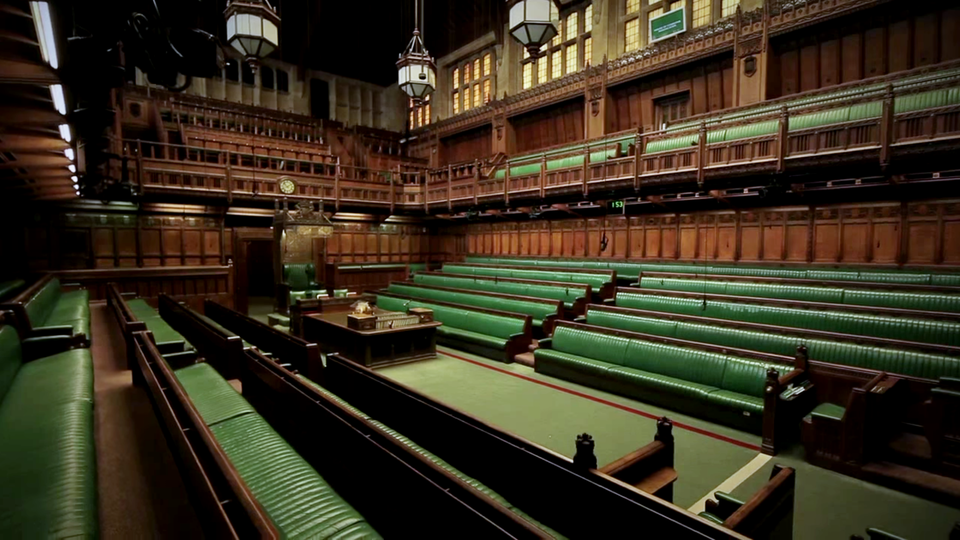
Image credit: UK Parliament (CC BY 3.0) via Wikimedia Commons
See the latest news & updates from VoteClimate.
Want to know how the UK is contributing to climate change? In this post, we look at the UK’s carbon emissions today and how they have changed over time.
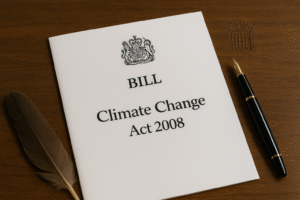
The Climate Change Act 2008 was the world’s first national law to set legally binding emissions reductions targets.